Wednesday, February 3, 2010

Metaphors for Peace

I am intrigued by all the metaphors for peace used by friends and colleagues in the peacebuilding field. John Paul Lederach in his book Moral Imagination uses spider webs to help give shape to how things come together for conflict transformation. In the Philippines, a network of organizations call themselves the Mindanao Peace Weavers to denote their efforts at weaving a tapestry of healthy, violence free society. Jay Rothman developed the ARIA framework which uses the harmony of voice and orchestra to describe an identity based conflict engagement. In our conflict analysis models we use icebergs, pyramids and egg shaped paradigms to describe the dynamics involved in war. People take what they know and apply solutions, frameworks and descriptors for addressing the conflict around them. It would make a fascinating study to collate the various metaphors that have informed our peacebuilding thinking.

I know electronics and it recently it dawned on me that my ability to read schematics would be a helpful metaphor in mapping conflict actors and interactions. While I never thought that the world of electricity could help shape my thinking about solutions to violence there is no reason why it should not. In writing the Mindanao Reflecting on Peace Practice document I used the phrase “theories of change schematics.”

A schematic, according to Wiktionary, is “a drawing or sketch showing how a system works.” In electronics a schematic is a pictorial representation of how some simple or sophisticated set of parts interacts to perform some function. Each part has a unique symbol denoting its role and value. The engineer designing a system knows the characteristics of each small part.

A schematic for peace would take into account how adding components with specific characteristics/values, will interact within the whole. I hope to develop this concept in the coming months. Maybe we will soon see electronics technicians adding their unique metaphorical understanding to the development of peace programs!

Wednesday, December 23, 2009

Surrender

Surrender is not in our vocabulary here in the US. It’s a dirty word denoting failure, cowardliness and weakness. In the church the language of “conquering sin” and “victory over death” trumps the word surrender. Even in peacebuilding, so much of the language and skills we promote are for the purpose of asserting our rights or obtaining justice. Not that any of this is wrong or misguided but some balance between victory and surrender is needed. In fact these two are intimately linked in the narratives of many a faith.

My work at peacebuilding, from previous posts, is acknowledged to be both personal and global. For the past number of years I have been an observer of the dynamics of violence. One facet in particular has commanded my attention and that is the addictive nature of violence. My tentative conclusions are from both first-hand and international vantage points. As a peacebuilder I am always looking for tools to assist those addicted to violence.

I stumbled upon the Alcoholics Anonymous 12-step program and realized that they had discovered a critical first step to making headway against any addiction…surrender. This is not the same as giving up. It is surrender to trying to overcome the addiction through sheer willpower by giving it over to a “higher power.” This surrender to a “higher power” will eventually include the giving up of any resentment, grudges and need for revenge. The AA people have documented these toxic attitudes as impediments to true inner peace. By taking responsibility for our own issues and shifting the burden of change to a “higher power” we will actually tap the ultimate power of the universe. Next time you are up against something seemingly unchangeable, surrender to your “higher power” and let the transformation begin.

Monday, November 16, 2009

An Average Day

I went to the office this morning and had an average day. First, as I was at my desk typing a letter when a giant meteorite crashed through the roof and landed square on my computer smashing it to bits. After chips, connectors and plastic finished falling I thought: "Now what do I do?"

I decided to file some of the stack of papers on my desk and walked toward the file drawer. Just as I pulled out the first stack of files a runaway truck came careening down the road, burst through the outside wall and smooshed the file cabinet flat against the opposing wall. After a blizzard of papers settled I thought: "Now what do I do?"

So I decided to photocopy some documents. While hunching over the copy machine a colossal wind blew through the window and pushed this sensitive apparatus right off the table. Glass shattered, springs sprung, and sparks flew. When the sprockets were finished rolling across the floor I thought: "Now what do I do?"

With the one side of my offices in disarray, I went to the library side with the hope of organizing some books. While working on the books, an alien spacecraft landed nearby, a three headed, green scaled beings from outer space walked into the library, pointed a wicked looking incoherent photon disruptor weapon at me and demanded our books. When the alien walked out with 5 tentacles full of absconded books I thought: "Now what do I do?"

I decided to call it a day.

When I got home that evening my wife, Carolyn, asked me: "How was your day honey?" "Oh", I said, "You know how it is here, I didn't get much done."

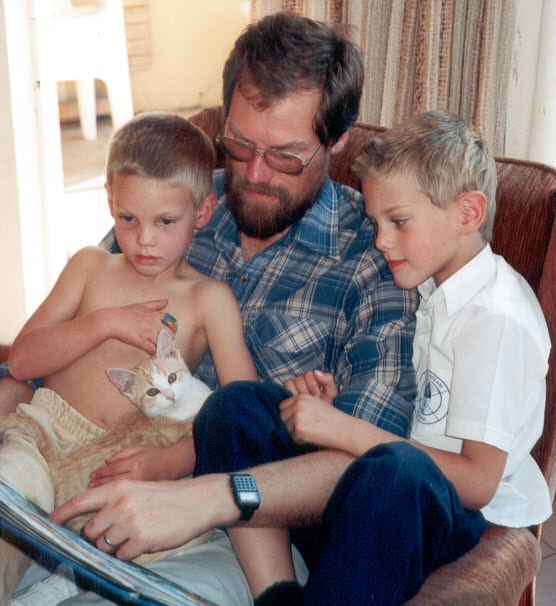
[Story told to Solomon (5) and David (3) Rudy at the supper table one evening to keep the boys seated and make them stop squirming, Swaziland Sept. '96]

Wednesday, November 4, 2009

Violence Debunked

A friend of mine once said that if war would bring peace, the human race would have achieved peace long ago. This idea exposes one of the lies about the use of violence to accomplish any kind of so social change, that ends and means can be inconsistent.

It is this incompatibility of methods and goals that has become such a blind spot in western culture today. From influencing a person to change their ways to nations being persuaded into giving up certain ambitions, the west continues to try to heckle, strong arm and bomb the other side into ‘correct’ actions.

I suppose the conventional wisdom is that the use of force is the most ‘rational’ course in many cases. However, how many of the ‘rational’ military adventures in this nation have started out as seeming the right thing to do only to become a quagmire once they are underway. Likewise, how many nonviolent campaigns start by looking like irrational and untenable efforts only to, in the end, bring real sustainable change? See http://www.nonviolent-conflict.org/PDF/IS3301_pp007-044_Stephan_Chenoweth.pdf for a hint.

Sunday, October 11, 2009

Connecting the Pieces of Peace

Something clicked in my head about the nature of my work while working on a sermon for Willow Street Mennonite Church. At the Mindanao Peacebuilding Institute (MPI) over the past 8 years I have co-facilitated courses on nonviolence, the basics of peacebuilding and how religion can be a source of conflict or a resource of peace. It strikes me that these three are on a continuum somehow for Christians.

One of Jesus' core teaching was to love our enemies. This is not just a 'nicey-nicey feel good stuff. It was his way of saying the work at making peace is with enemies, not friends and in order to do that you gotta move toward tough spots in relationships. This is the way it is when conflict sides fall on the fault lines of faith. We have to get together and talk with our religious neighbors, not just about the commonalities and points of overlap but the tough things that could divide us. In so doing, respect and tolerance are generated.

Jesus says that we will be blessed in our peace making. Blessing is such a nebulous word. But I can tell you from experience that anyone who has experienced the calm of peace after the storm of violent conflict feels blessed. The hard work is to refine skills of peacebuilding so that they become the norm out of which people seek to address conflict not violence.

Jesus' life demonstrated that nonviolence is the only way to undo the spiral of violence in which humans are trapped. Our commitment to non-retaliation is costly. It is not popular and makes no sense. But if I have learned one thing it is that the use of violence to solve problems, while seeming to be the logical choice at the beginning quickly spirals into irrationality.

So these three topics - dialogue, peacebuilding and nonviolence- are intimately linked. I suppose these three are what make sense to me because they are in such short supply in the world today. I suggest you read my mentor/friend Deng's blog to see how blending these three are making a real-life impact.